

July 21, 2026.
Ebola is still on the rise. This morning we learned that only 20% of the resources committed to the fight against the virus have been delivered. That translates to subhuman conditions in the places where people are being quarantined for 21 days if they’re among the contact list of the sick, or if they’re crossing the borders. No water. No food. No medical care. No protective clothing for the staff, if there are any… There is still no new treatment, though some are being tested in some places. International response is muted, partly because of politics.
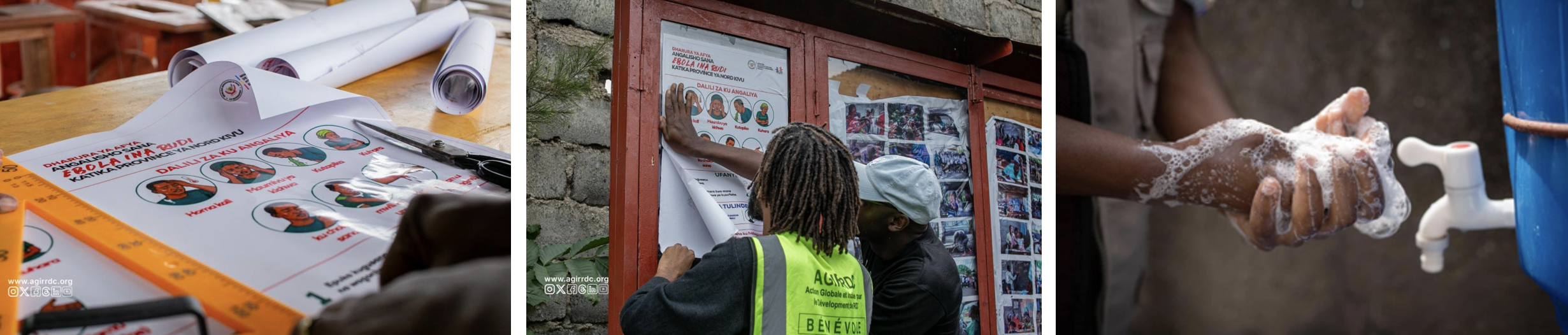
AGIR is part of the coordinated civil society/OCHA response in Goma and in Beni. Trusted messaging and messengers remain key to prevention of disease. Hygiene and traditional funereal practices are key factors in transmitting this disease. AGIR has made posters, radio dramas, and poetry to make people aware. Follow them on social media platforms.
We can send money that can provide food, and some other items available locally. Your contributions are going to this now. Thank you!
Your support is critical in this work that AGIR is undertaking today, for the future!



AGIR-RDC News:
We are delighted to share this section of our website so that you can see what our partners report about their work. They received professional training in media, photography and storytelling, and here’s the proof. We translate to English directly but make minor adjustments when the online translating services don’t quite get the nuances…
Please also follow them directly via Facebook, X and Instagram.
Twa Weza Shinda enters its fifth year…a note from ACT for Congo.
AGIR is based primarily in Goma, DR Congo but they also work in the North Kivu region more generally. The stories you will read here come from their work with people in Bulengo-Mugunga, Sake, Beni and Virunga National Park. (See the maps below.)
For years, AGIR’s team members have been working to help vulnerable people gain life skills, vocational training and the confidence that will help them become independent, respected, support their families and “pay it forward” in their own communities. Since 2021 they are focused on the multiple crises of internally displaced people.
Domestic workers are often also displaced people, minors, female and abused by their employers. UFEDOC is AGIR’s partner formed in 2018 to help domestic workers know and claim their rights, improve their skills and raise awareness within the community.
AGIR RDC works to foster:
Mentally stable, capable people who know how to get accurate information and act on it.
Economic and social stability and dignity for all Congolese.
Parents who can provide food, shelter and education for their children so that they can enjoy life in their own communities.
Viable ways for people to transition out of the dependency that emergency situations create, into a new reality with the skills required in their new environment.
A path for Congolese to thrive in peace in their own country.
AGIR completes their fourth year.
March 2025: AGIR brings mattresses and water to looted health center.
Twa Weza Shinda means "We will succeed together again." AGIR has been working with people who've lived with multiple displacements. Cycles of loss and rebuilding. AGIR's role has been to offer counseling for mental health, information and accompaniment as people learn new skills to rebuild their lives, create savings and loan associations, and create small businesses based on real services needed in DR Congo. It also incubates young organizations so that they will have the knowledge and systems to build their capacity as well.
Learn more from them directly in these videos and stories produced in Goma.
AGIR interviews people fleeing toward Goma.
AGIR-RDC works in this region:


May, 2023 — Stories of hope
Opportunities for children forced out of school by poverty or violence are few and far between. AGIR recognizes that young people aged 15-35 who are not in school or employed are easy targets for militia recruiters.
AGIR developed Peace Clubs to provide alternatives. Two young men share their stories.

April, 2023 Photo Report
AGIR continues to accompany people as they learn new skills and new ways of living together. Counseling, family mediation, therapy groups, vocational training and savings and loan associations are part of ongoing programs like Twa Weza Shinda — which means “We Will Succeed Again.”

March, 2023 Photo Report
In DR Congo, tailoring is a respected skill. There is no ready to wear industry. The traditional clothing is made from woven cloth that must be perfectly fitted to the wearer’s body. These tailors look forward to running their own ateliers.
AGIR’s training prepares women to take the National Juried Exam, which provides them with a state-issued certificate when they pass.

February 22, 2023: BULENGO — What it costs to be a displaced person
One would think one is nowhere, in space, in nothingness, in an empty expanse. You could believe you are in amplified denial, a nowhere complete indifference, or in a nonsense world. Well, we are not far from it.
We are in Bulengo, more or less 15 km from the city of Goma. A camp for displaced persons has been erected here. Like the other camps in the north in the Kibati territory, it also hosts displaced populations fleeing clashes between M23 rebels and the Loyalist Army. Here, they are even more numerous, crammed into their makeshift shelters, lost on a perimeter where they are forced to cohabit with methane gas. In the inter-agency meetings in which AGIR RDC participates, we are talking about 80,000 people here. Many needs, but especially those fundamentally primary. We have about 50 toilets for almost 100,000 people. A toilet for 2000 people then? Very alarming.
Photo AGIR DRC, February 20, 2023

February 20, 2023: We are on the third day of our emergency project "TUSI WA ACHILIYE BULENGO I". As every morning we arrive, and after having aimed the mission order with the camp authorities, we spread ourselves around the camp. Some, the mobilizers, enter the camp, the psychological assistants head to the listening house where some displaced people are already waiting for them, and the last team heads to the inter-agency meeting for a briefing between all the humanitarian actors working in the camp.
Photo AGIR DRC, February 2023

February 10, 2023: FAMILY REUNIFICATION ACTION SAKE-BULENGO
Since February 9, thousands of displaced people have flocked to the city of Goma fleeing clashes around the city of Sake. Several families had to travel on foot for a distance of 27 km as the crow flies. But also several other families arrived scattered, children separated from their parents and family members. As displacement was immediate, many families did not have the opportunity to reunite before fleeing.
Beyond the assistance to live, the erection of shelters, there is the urgent need for action to reunite families, an action to serve the stability of the mental health of the concerned but also for their protection. This could be complemented by other forms of assistance, at least for reunited families, although this can be done concomitantly.
Photo AGIR DRC, February 2023